
First off, here's a summary table of all the Laptop, Tiny PC, and Linux combinations I have successfully installed:
| Sony | Vaio PCG-N505X | Red Hat 6.2 |
| Sony | Vaio PCG-N505X | Red Hat 9.0 |
| Sony | Vaio SRX-51P/A | Red Hat 9.0 |
| Sony | Vaio SRX-51P/A | openSUSE 10.0 |
| HP | Omnibook 500 | openSUSE 10.2 |
| Asus | eee PC701 | openSUSE 10.3 |
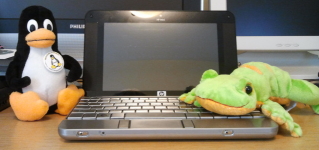
| HP | Mini-Note 2133 | openSUSE 11.0 |
| HP | Omnibook 500 | openSUSE 11.1 |
| HP | Mini-Note 2133 | openSUSE 11.4 |
| Asus | eee PC701 | Android-x86 2.2.2 |
| HP | Omnibook 500 | openSUSE 12.1 |
| Asus | eee PC701 | openSUSE 12.1 |
| Asus | Zenbook UX31A | openSUSE 12.2 |
| Asus | eee PC701 | openSUSE 13.2 |
| Intel | Compute Stick STK1A32SC | openSUSE Tumbleweed 20161226 |
| HP | Mini-Note 2133 | openSUSE Tumbleweed 20170521 |
| Samsung | Chromebook Plus | openSUSE Tumbleweed 20170615 |
| Asus | Zenbook S UX391U | openSUSE Leap 15.0 |
| Samsung | Chromebook Plus | openSUSE Leap 15.0 |
| Asus | Zenbook UX31A | openSUSE Leap 15.0 |
| Raspberry | Pi 4 Model B | openSUSE Leap 15.2 |
| Intel | Compute Stick STK1A32SC | openSUSE Leap 15.2 |
| Asus | Zenbook UX31A | openSUSE Leap 15.2 |
| Samsung | Chromebook Plus | openSUSE Leap 15.2 |
| Asus | Zenbook S UX391U | openSUSE Leap 15.2 |
| MeLE | Quieter 3C | openSUSE Leap 15.4 |
| Orange | Pi 5 | openSUSE Leap 15.4 |
| Asus | Zenbook S UX391U | openSUSE Leap 15.5 |
| Samsung | Chromebook Plus | openSUSE Leap 15.5 |
| Raspberry | Pi 4 Model B | openSUSE Leap 15.5 |
| Orange | Pi 5 | openSUSE Leap 15.5 |
| MeLE | Quieter 3C | openSUSE Leap 15.5 |
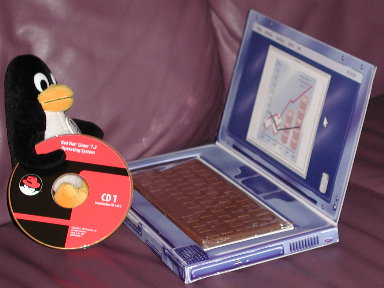
In early 2000 I acquired a Sony Vaio PCG-N505X, and ran Red Hat Linux 6.2 on it for nearly 4 years. In mid-2003, it became time for some new hardware and software, so I went for its descendant, the Vaio SRX-51P/A and installed Red Hat 9.0 on that.
Having successfully got RH9.0 up and running on the SRX-51, I then cloned the config from its hard disk onto a new hard disk which I brain-transplanted into the N505X.
Jun 2006
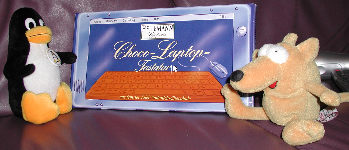
Although both my (non-edible :-) laptops were still going hardware-wise, Linux had come a long way since Red Hat 9.0, and I successfully installed SUSE 10.0 on my SRX-51 and upgraded its internal WiFi card to 802.11a/b/g.
SUSE 10.0 worked very nicely on this laptop, mostly out the box without any of the kernel-tweaking needed for Red Hat. Upgrading the internal miniPCI network card to a 802.11a/b/g Netegriti WiFi card was also fairly straightforward, and it worked well. I was even able to get suspend-to-disk and a bluetooth mouse working at long last :-)
I also tried SUSE 10.1 on this laptop, which was not a good experience for the following reasons:
This appears to be fixed in openSUSE 10.3 onwards.
downloaded seperately from here.
The drivers for the original Orinoco 802.11b wireless card supplied in this laptop seem okay.
Shortly afterwards I installed openSUSE 10.2 on my HP desktop, and had a rather better experience with that.
Dec 2007
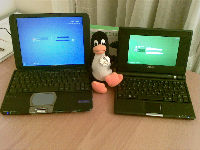
Unfortunately time and travel took their toll on my trusty SRX-51, and it eventually started to show its mileage, so I bought a tiny new Asus eee laptop :-) It is great this comes with Linux pre-installed, though I was not massively impressed with the Xandros distribution it came with.
As a consequence I have got openSUSE 10.3 working on it, a tight fit into the 4Gb internal flash, but doable. A summary of how to do this with grateful thanks to all the folks at the EEE User is available here.
Dec 2008
The eee was a great stop-gap, and ocassionally useful for short and non-work trips. But I needed something more serious, so got a custom-built max-spec version of the HP 2133 Mini-Note, which came pre-installed and certified for Novell's SLED10SP2 version of SuSE Linux :-) I however scrubbed this in favour of openSUSE 11.0 after good experiences with the latter on a new server, and it installed on the HP2133 more or less out the box.
There were however some points worth commenting on:
Everything else, including suspend and bluetooth, works nicely :-)
Jul 2009
I'd really like to be an advocate for openSUSE, it mostly works very well.
Just upgraded two openSUSE 10.2 systems (my main desktop, and an HP Omnibook 500 aging laptop)
to openSUSE 11.1. Overall, the package management is much smoother, and lots of things work well,
including a D-Link DWA-642 PCMCIA wireless card using the ath9k driver. BUT:
Aug 2011
I have now upgraded my HP 2133 to Open SUSE 11.4, including swapping an Intel 80Gb SSD in for the hard disk, and finally migrating to a KDE desktop. On the whole, it works great, though the VIA chipset in this machine is a little underpowered for KDE4. Finally got an openchrome video driver (some custom config was needed - see here) that actually supports video playback, though again there's not quite enough juice in there to play MPEG2 back at 720p resolution. The external video port can just about be coaxed into working, though only if you re-start X with the external VGA port both configured and connected, and the screen and resolution has to mirror the panel display. And configuring "disable desktop effects" in kpowersave causes random "black screens of death" which can only be recovered from by killing and restarting X. I am never going to buy another PC with a VIA chipset in it, their open source graphics support is just a mess.
There's also a known issue with knetworkmanager where it is possible (e.g. after USB tethering to an Android device, or using the wireless switch to disable WiFi) to lock the network off and not be able to re-enable it without re-starting the entire network stack (including removing and re-inserting the various ndis kernel modules) or a hard reboot. Looks like knetworkmanager should now support 3G sticks and OpenVPN out the box okay though, have not tried this.
Suspend is a bit visually messy but works okay, though requires a swap paritition to be configured, which in turn even with 2Gb RAM gets used for swapping during regular operation of the machine - this use of the SSD makes me nervous but I think the netbook will reach the end of its life before the SSD wears out.
Nov 2011
I tried Thunderbird v6.0 when I first installed 11.4, and the performance has been awful, sometimes it just seems to get stuck forever when doing an off-line sync, and even worse when typing text into an edit window on an otherwise idle machine the display echo can lag by 5-10 characters ! Upgraded to Thunderbird v8.0 to see if this helps things, it does a bit, but requires frequent mailbox folder compacting to avoid going sluggish - this laptop is just not quite powerful enough to use current Thunderbird as its mail app :-( Firefox meantime seems to guzzle 10-20% of CPU continuously even when idle and minimized.
Aug 2012
Got openSUSE 12.1 working on both the eeePC 701 and the Omnibook 500, having upgraded the RAM on the eee to 2Gb, and it's SDcard to 32Gb. On the eee, this lets me dual-boot Android and SuSE, splitting the internal SSD between 2Gb /boot and 2Gb swap/resume (though I disabled actually swapping to the (non-replaceable/upgradeable) SSD to avoid wear, the idea being to use this purely for suspend-to-disk). All other paritions including SuSE root are mounted off the external SDHC. Getting suspend/resume to disk working is a challenge, though - while it is possible to suspend to the SDHC card, there's issues with the powerdown sequence to the USB interface it is connected via that may cause corruption of the suspend image, and certainly corrupt the root filesystem during suspend if root is mounted from SDHC. Suspend/resume can work off the internal SSD, provided that the ata_piix module is added to the initrd. However, there is not enough space on the SSD for both a root filesystem and suspend partition, so this may be a non-starter. It is also really pushing the performance of this machine to make it run a KDE4 desktop, even on an external monitor. It still makes a great Android toy, though.
The 10-year old Omnibook runs openSuSE12.1 suprisingly well, however, even with only framebuffer graphics due to the above ATI/mach64 driver problem (needs "nomodeset" in kernel boot parameters). These USB2 Cardbus cards work very nicely for adding faster USB to old laptops.
Sep 2012
Further hassles with knetworkmanager, and USB Android tethering only seems to work if I blacklist the rndis_wlan kernel module and remove the rndis_host module after disconnecting the phone each time.
Oct 2012
Just got an Asus Zenbook UX31A, which is a lovely machine in all kinds of ways, especially the 1920x1080 non-shiny 13" screen :-) The almost entirely Intel-based silicon is also hopeful for avoiding the video and network hardware issues I've had in the past. Install of openSuSE 12.2 x86_64 has gone pretty smoothly - finally enough CPU/GPU power to run KDE4 properly. Watch this space...
Feb 2017
Four+ years later the Zenbook is still going great, plenty of performance still. The hardware is getting a little crumbly after 400,000+ miles on the road now, and while I've managed to source some parts and effect some repairs, Asus' policy of neither publishing service manuals nor selling parts makes me reluctant to buy another one.
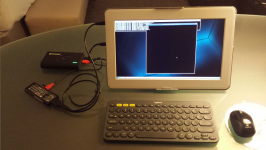
Meantime I've been trying the very latest openSUSE Tumbleweed releases on my "sticktop", or "emergency backup laptop", something I've been noodling around with for the past few months. The idea is that by combining an Intel Compute Stick, keyboard, and various other of the parts I carry around with me, and/or a hotel room LCD panel or VNC tablet, I can avoid having a SPoF for my preferred computing environment on the road.
It's running KDE5/Plasma under Tumbleweed, and as shown can even run completely off a large USB battery. The portable LCD panel (GeChic) also doubles up as a second monitor for my regular laptop.
In practice there's a few issues with this
May 2017
So it seems the latest aviation security theater means we'll have to travel with burner laptops :-( To that end, I've resurrected my robust-but-cheap trusty HP2133, and got the latest Tumbleweed for i586 running on it. The updated openchrome video driver means I can dual-head my external LCD HD monitor, plus an ExpressCard gives me 2 extra USB ports at USB3 speeds, so looking like a new lease of life for this old friend :-)
June 2017
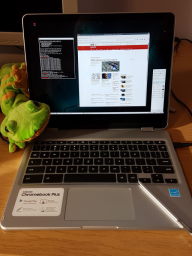
The HP2133 "burner" setup works remarkably well, but the 8yo hardware is slow. So I've got a Chromebook Plus to try a more modern variant on a privacy-safe international traveler laptop. Hardware is lovely, but this is my first attempt at installing SUSE on a 64-bit ARM target, so rather more assembly required than usual...
October 2017
Tumbleweed for aarch64 now essentially working on the Chromebook Plus :-) Main wrinkle is that none of the available SuSE kernel/bootloader combos can boot on this platform (they are all either for 32-bit armv7 Chromebooks or generic 64-bit ARM platforms), so needed to use an Arch Linux kernel boot partition together with a SuSE rootfs. Also some wifi issues to smooth out, more in due course..
And it's working out very nicely as a short trip/burner laptop, but is a bit too underpowered for serious work. At least some of this is down to lack of Linux distro support for the ARM Mali GPU, though it looks like the various bits of code to make this happen are out there, just need putting together. Also my preference for a KDE desktop is somewhat demanding, though it seems like the KDE folks have been working on ARM performance optimizations and want to try these when I get a chance. Wish there was SUSE support for Crouton and/or Crostini.
November 2018
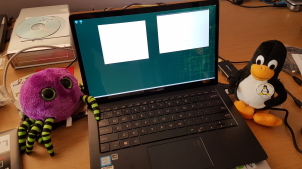
New power tool - Asus Zenbook S :-) Initial SUSE Leap 15.0 install looks to have gone very smoothly indeed. Only three issues so far:
Only other non-Linux annoyances are the keyboard, chiclet disease like most other laptops these days, and the ability of the nice blue case to atttract fingerprints. Otherwise my nicest Linux laptop install ever :-)
December 2018
With Leap 15.0 working nicely on the Zenbook S, and the availability of a Leap 15.0 aarch64 port, took the additional step of upgrading the Chromebook Plus to Leap 15.0. So now have same distro running on both primary x86_64 and secondary aarch64 laptops :-) Used the same Arch linux instructions above to partition the uSDcard and install a slightly-newer Arch-packaged ChromeOS kernel, then a "zypper dup" on a clone of the running Tumbleweed rootfs. Note it's necessary to copy the kernel modules and firmware across from the Arch rootfs to the SuSE for full functionality. Although there is still no Mali GPU or xrandr support, this upgrade seems to have improved KDE GUI performance significantly, feels more snappy. Some issues with network interface lockups I'm trying to figure.
July 2020
The Zenbook S has turned out to be something of a disappointment. The keyboard is horrible, the worst I've had on any computer in 30-odd years, a chiclet with almost zero travel or feedback. It took a couple of months' of use before two of the keys even worked reliably. While a 4K screen is nice in principle, at 13" it's fiddly to get many apps to display with a readable font size. And unlike the UX31A's nice matt screen, it's unplesantly shiny.
Worst of all, the battery has died after just 18 months of moderate use :-( I've not had a laptop do this to me in 20 years. Was not hard to replace battery off eBay.
From an OS point of view, it's fine, plenty of performance, and successive kernel updates have resolved the suspend and audio issues above. Will be attempting Leap 15.2 upgrade on it, the UX31A, and Chromebook Plus.
August 2020Decided to give a Raspberry Pi a spin, first openSUSE install, Leap 15.2 on a Pi4. Has a few shortcomings, especially from the laptop substitute PoV:
But apart from these niggles, amazing value for money, and runs openSUSE pretty smoothly overall.
October 2020
Upgrades to Leap 15.2 for Zenbook UX31A and Intel Compute Stick went smoothly. Leap 15.1 shipped with a rather old kernel with no Cherry Trail support, so the much more recent 5.3.18 kernel in 15.2 helps the compute stick quite a bit - finally supports the eMMC slot, and HDMI audio, making it more useful. It is pretty slow compared to the Rasp Pi 4, and although hibernate worked on Tumbleweed, with Leap 15.2 it simply will not restore from hibernate, not much use as a laptop alternative.
November 2020
Next up was a Leap 15.2 upgrade for my Chromebook Plus. Seems good so far, but I've not been able to locate a better bootable aarch64 kernel for it than the 4.4.159 version from Arch Linux, nothing more recent either boots or is available in a Chromebook-bootable format. So it's way behind the Leap 15.2 and Rasp Pi 4 curve kernel-wise at present.
December 2020
And my main laptop, the Zenbook S, completes this round of 15.2 updates. Mostly straightforward, biggest issue is the upgrade swapped out the xf86-video-intel X display driver for the modesetting one, and the latter does not appear to support the external USB-C video ports. Re-installing the intel driver and disabling plymouth boot/splash mostly restored this, but there is some remaining flakiness with some monitors. Hibernation to disk also busted, and of course systemd makes hibernation debugging almost impossible. Suspend to RAM okay at least.
February 2023
Got increasingly annoyed with my Zenbook S, the butterfly-era chiclet keyboard is truly dreadful, the touchpad randomly goes crazy-input mad, and whether or not the external USB-C video outputs work after a given re-boot is non-determinstic, despite my best efforts to reproduce what causes that or not, and various attempted fixes (ref above).
As an interim alterative to a new laptop, and an evolution of the Compute Stick solution, I got a MeLE Quieter 3C mini-PC, full x86_64 machine in a form factor not much bigger than a smartphone. Did my first install of openSUSE Leap 15.4 on this, and it has worked out well. With a Logitech MX Mini keyboard and portable QHD LCD panel monitor (or two), it's a viable laptop alternative, and can even run off a wall-wart USB-C PSU via a single cable feeding power+video between the PC and monitor.
Unlike all the above laptop-alternative portable boxes I've tried, it properly supports hibernate/suspend-to-disk on the internal eMMC or NVMe drives, even with bluetooth keyboard+mouse, so usable on the road. Its hardware and external interfaces appear to just work out the box with Leap 15.4. Now to 15.4 all the things..
April 2023
The Chromebook Plus remains one of the nicest ARM-based laptops around, and mine is still going strong as a secondary/short trip device. It has always however been a litte underpowered for a full Linux distro, and app growth is making this worse over time. Kudos however to Mattermost, ARMCord, Teams-for-Linux, and Master PDF Editor for supporting aarch64 binary releases to their products, which keep it useful (Note Well Zoom and Google-Chrome..).
The Rockchip 3399 driving the Chromebook Plus seems like an effective
architecture, so when a reasonably-priced board with the more powerful
successor Rockchip RK3588 and 16Gb RAM came out, the
The RK3588 seems to have at least as much compute power as the MeLE's
Celeron N5105, with rather better (5V-only) energy efficiency. GPU
support (ARM Mali G610) is better than any SUSE /aarch64
combination I've tried so far. However, ARM SoC sleep/hibernate
support seems as lacking as ever, and that and the supplied case do
not make this device as good an option for travel use.
July 2023
Done a round of Leap 15.4 to 15.5 upgrades on 8 of my 12 active Linux devices now, including taking the Zenbook S to 15.5 with a fresh SSD. While this fixes a bunch of annoynances that had emerged with this laptop, it still cannot:
There's also new issues with Android USB connectivity since 15.2, in particular USB tethering no longer works.
February 2024
Thirteen upgrades from Leap 15.2 to 15.5 (and a couple still on 15.4) later, and much to my annoyance, I find that USB tethering to Android phones stopped working because it was deliberately turned off. Grrrr, before it was replaced with any working alternative. I don't use this capability much, but when I do, it's generally on-the-road essential that I need to be able to use it. No thanks at all to high-handed kernel developers making unilateral decisions about my threat models, or to the openSUSE folks who couldn't be bothered to note this signifcant regression in the release notes.
It is battling against stuff like this that has meant it's taken nearly 10 months to upgrade my dozen-odd SUSE systems. Does not feel like this lark is getting any easier.
Anyway, the fix is to over-ride /lib/modprobe.d/50-blacklist-rndis, at least for now.
In better news, the upgrade from 15.4 to 15.5 for the Orange Pi5 was pain-free.
Finally, thanks to all the people who have contributed entries to Linux Laptop pages, and in particular those whose links I have listed for convincing me that it was even worth trying to get Linux up on these nice pieces of hardware.